
Young Artivist Club Showcase - Trinity City Arts x Morris Jeff High School
- Isabelle Chirls

- May 8
- 3 min read
Guest post written by Anna Skerrett.
Tuesday, April 21st, 2026 marked the culmination of months of work for the Young Artivist Club students at Morris Jeff High School. At 8am, community members and students at Morris Jeff gathered in the art room for the Trinity City Arts x Morris Jeff High School Young Artivists Club Showcase “WE ARE PEOPLE: The Criminalization of BIPOC Youth.” The projects showcased included Animal Ambulance, We are People, and School Systems. This showcase was an opportunity for students to change the narrative through their projects. As part of making this narrative change, some notable audience members were Tulane Sociology professor Cameron Leahy, Judge Calvin Johnson, and Sierra Gaines of the New Orleans Youth Alliance.


The first project was Animal Ambulance. Animal Ambulance was a collection of poetry and visual art drawing parallels between the treatment of animals and of BIPOC and immigrant communities. The group’s poet, Genesis, has the power to leave a message between the lines of her poetry. But, the group chose not to leave their message unspoken. Evelia and Kasha visualized their interpretations of each written piece. Throughout Animal Ambulance’s presentation, the poems were though-provoking. But, the visualizations made my heart drop. This project used a deliberate combination of written and visual art to communicate problems that are difficult to speak. Following their presentation, the audience discussed how people of color are both treated like animals and how, historically, animals have been treated better than BIPOC.
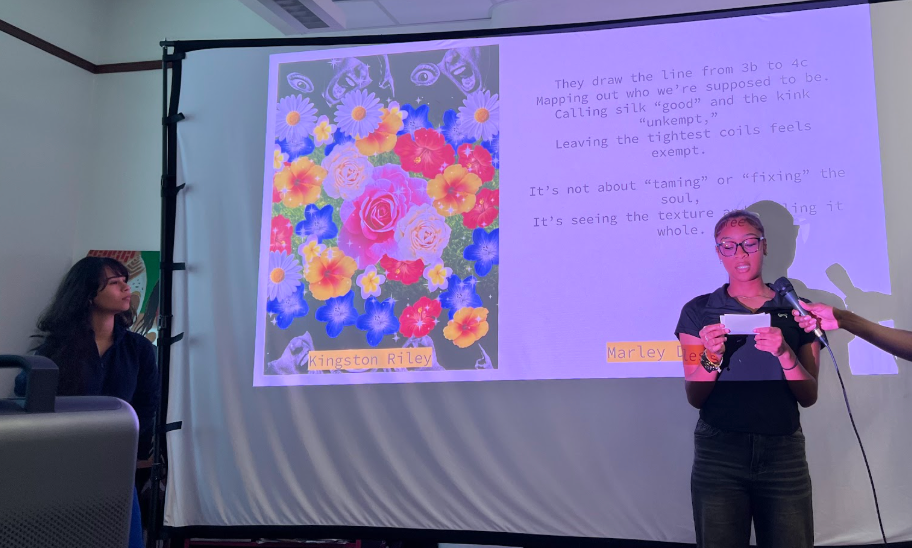
The second project was “We are People,” a multimedia presentation dismantling harmful stereotypes within BIPOC communities. This project challenged stereotypes from many angles. Jamie’s drawing challenged eurocentric beauty standards, Kingston’s collage evoked the complexity of Black queerness, and poems by Evelyn and Marley rebutted there being only one correct way to speak or to keep coily hair, respectively. While each piece targeted a different stereotype, the project was seamless and focused. “We are People” showed that stereotypes are never harmless and are always connected. Judging someone for how they look, speak or for who they are is contrary to taking pride in one’s identity.

The third and final project was the skit “School Systems,” written and performed by Kaliyah, Nyleaj, Quane, and Kailon. The skit showed two poignant realities for current high school students. First, the students arrive at school to be searched and forced through metal detectors. Repeatedly, the student is told they better not have a phone on them. Then, the student goes home to reluctantly share how each morning at school goes with her father. At the end of the skit, “School Systems” asked the audience to walk out of the classroom and into the hallway if they agree that the current treatment of students must change. Everyone walked out of the classroom. Following the presentation and demonstration of support, the audience had more things to say than time to speak. Adults shared their shock at the way students were treated and expressed the skits resemblance to incarceration.
“WE ARE PEOPLE: The Criminalization of BIPOC Youth” was a thought-provoking and change-creating experience. The students used visual art, writing, and theater to show how social problems needed narrative change. Following the presentations, community members in attendance commented that they needed to share what they learned with leaders including the city council and the school board. The audience shared that seeing young people present these projects gave them hope. What started as an idea for the Young Artivists Club project became seeds for change.


Comments